
Micron: does a strong business make an attractive stock?
A strong business does not automatically make an attractive stock. Micron’s memory demand must translate into durable earnings and cash flow, while valuation and the entry setup need separate tests. Its September 2026 relative-performance evidence supported recent leadership, not an unconditional buy conclusion.
The business question
Can Micron turn demand for memory and storage into durable profit and cash flow—and how much of that success does the share price already assume?
Micron produces DRAM and NAND; high-bandwidth memory (HBM) is a specialised form of DRAM. AI demand can support memory usage, but manufacturing yields, selling prices, product mix and capital spending determine the economics. More demand does not automatically produce a better shareholder return. [1, 2]
The evidence at the report’s cutoff
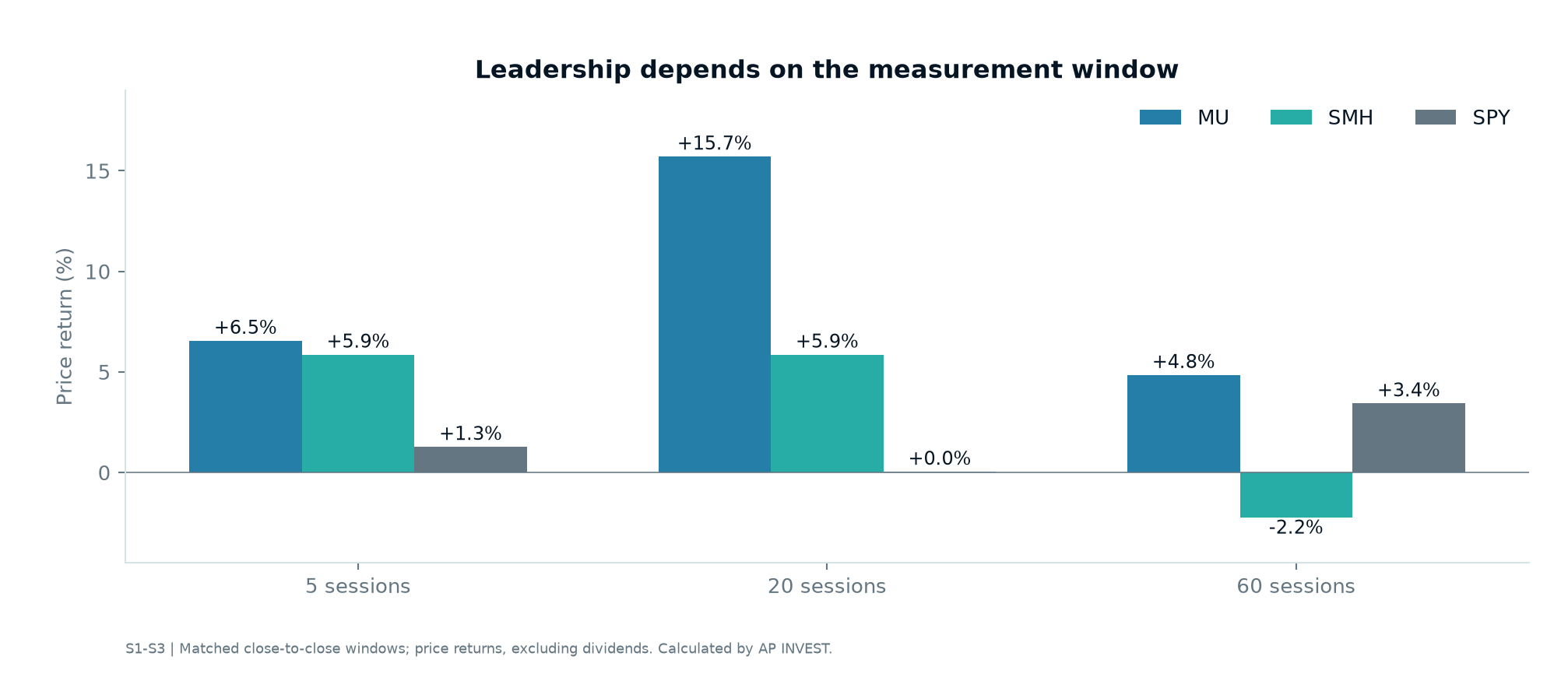
The 26 September company report compared MU with semiconductor ETF SMH and broad-market ETF SPY. Over the matched 20-session window, MU gained 15.7%, SMH 5.9% and SPY approximately 0.0%. Over 60 sessions, MU gained 4.8%, SMH fell 2.2% and SPY gained 3.4%. These are the report’s historical observations, not today’s prices.
 COMPANY ANALYSIS / MICRON / 25 SEP 2026
Interpretation: momentum is evidence, not valuation
The recent window supported a leadership reading: MU outperformed both benchmarks. The longer window made that reading more qualified. Its 1.4-percentage-point lead over SPY was much smaller than the recent 15.7-point lead. A strong rebound had not established uninterrupted leadership.
The business hypothesis was also conditional. Stronger demand would need to translate into qualified shipments, sustainable pricing and manufacturing execution. The next question was whether operating profit would convert into cash after investment. The price comparison cannot answer that question or establish fair value.
What would weaken the conclusion?
- Business hypothesis
- Repeated evidence of weaker realised pricing, poorer manufacturing yields or rising inventory alongside softer demand would challenge the assumption of durable earnings. Heavy spending without corresponding cash generation would weaken the cash-return case.
- Stock leadership
- A new price high accompanied by persistent underperformance against SMH and SPY over the same chosen window would weaken the leadership interpretation. A single weak session is insufficient to establish that change.
- Entry setup
- Failure to hold the specific confirmation level chosen for a setup would invalidate that setup. It would not, by itself, prove that the whole business thesis was wrong. Rebuild the evidence before defining another entry.
What this example does—and does not—conclude
The source report was constructive on the observed recovery and conditional on follow-through. That is a narrower conclusion than “AI demand makes MU a buy.” A business can perform well while its stock disappoints if expectations are already high.
This public note shows how to separate the questions. It does not supply a current valuation, a price target or a claim about subsequent returns. The original pre-earnings edition should not be read as an updated earnings assessment.
Sources & scope
[1] AP INVEST Micron Company Analysis, prepared 26 September 2026: research pages 1–3 for the business and thesis; page 5 (PDF page 7) for the figure and returns. Market cutoff: 25 September 2026, regular US close. S1–S3 use matched unadjusted daily closing prices; dividends excluded. Values are reproduced from the report, not independently recalculated for this article.
[2] Micron Form 10-Q for the quarter ended 28 May 2026: product definitions, manufacturing and investment risks. Filing checked 2 October 2026 for business context; this is not an independent review of the AP INVEST report.
SMH is a semiconductor benchmark, not a pure memory basket or an independent control; it can hold MU. Historical educational research, not a trading record. The article separates observations from conditional interpretation and does not claim calibrated probabilities.