AI chips or nuclear power? What Google’s Constellation deal means for investors
AI needs computing power and a reliable electricity supply. Investors can own different parts of that system, but each earns its return differently. Google’s agreement with Constellation is a useful test of where demand becomes durable cash flow—and how much optimism is already in the share price.
Start with what is new—and what already exists
On 6 October 2026, Constellation and Google announced a 20-year power purchase agreement supporting 890 MW of additional nuclear capacity. It involves upgrades at 11 nuclear units, with the first uprate expected by 2028. Constellation described more than $4.3 billion of new investment. A separate 15-year agreement covers 2,700 MW from existing generation assets.
Constellation announcement, 6 October 2026 ↗
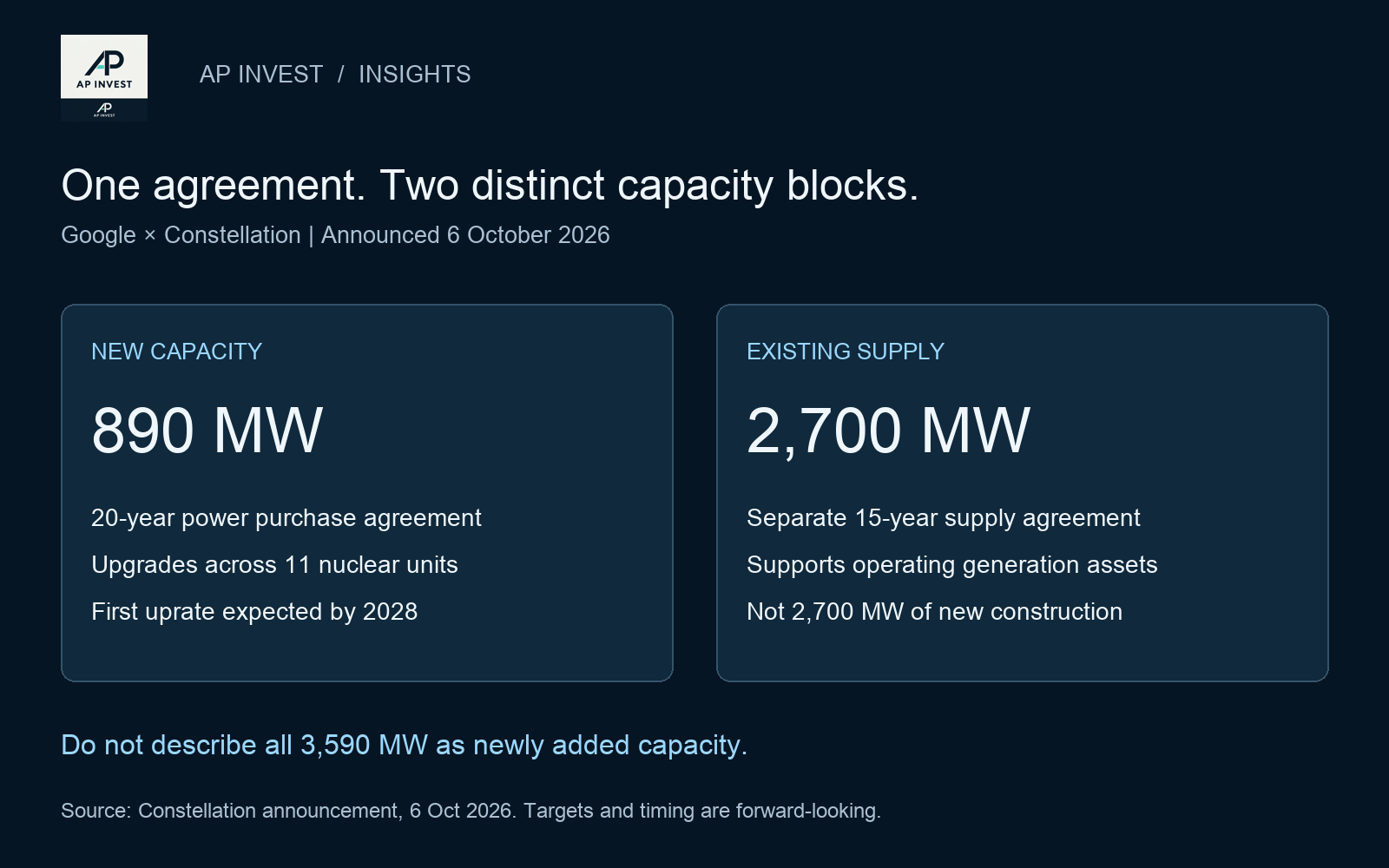
The distinction matters for modelling. New output can expand the production base; contracting existing output can change revenue visibility and price exposure. Adding the two blocks together and calling the total new generation would confuse different economic effects. The investment amount is also not a disclosed contract-revenue total.
The stocks: direct participants and a chip comparison
Constellation Energy (NASDAQ: CEG) is the electricity supplier. Alphabet Class A (NASDAQ: GOOGL) represents Google’s parent company, on the demand side of the power agreement. NVIDIA (NASDAQ: NVDA) is included as a semiconductor comparison for the original chips-versus-power question; it is not identified as a party to this agreement.
The snapshot below uses 7 October 2026 regular-session closing prices at 4:00 p.m. New York time (8 October, 4:00 a.m. Hong Kong). All prices are USD. Changes compare with the 6 October close; these are not live or pre-market quotes.
| Company / ticker | Close (USD) | Daily change |
|---|---|---|
| Constellation Energy (CEG) | $299.59 | -0.81 (-0.27%) |
| Alphabet Class A (GOOGL) | $350.50 | +2.82 (+0.81%) |
| NVIDIA (NVDA) | $237.47 | -1.77 (-0.74%) |
Price sources: CEG · GOOGL · NVDA. Cross-checked against Yahoo Finance daily closes.
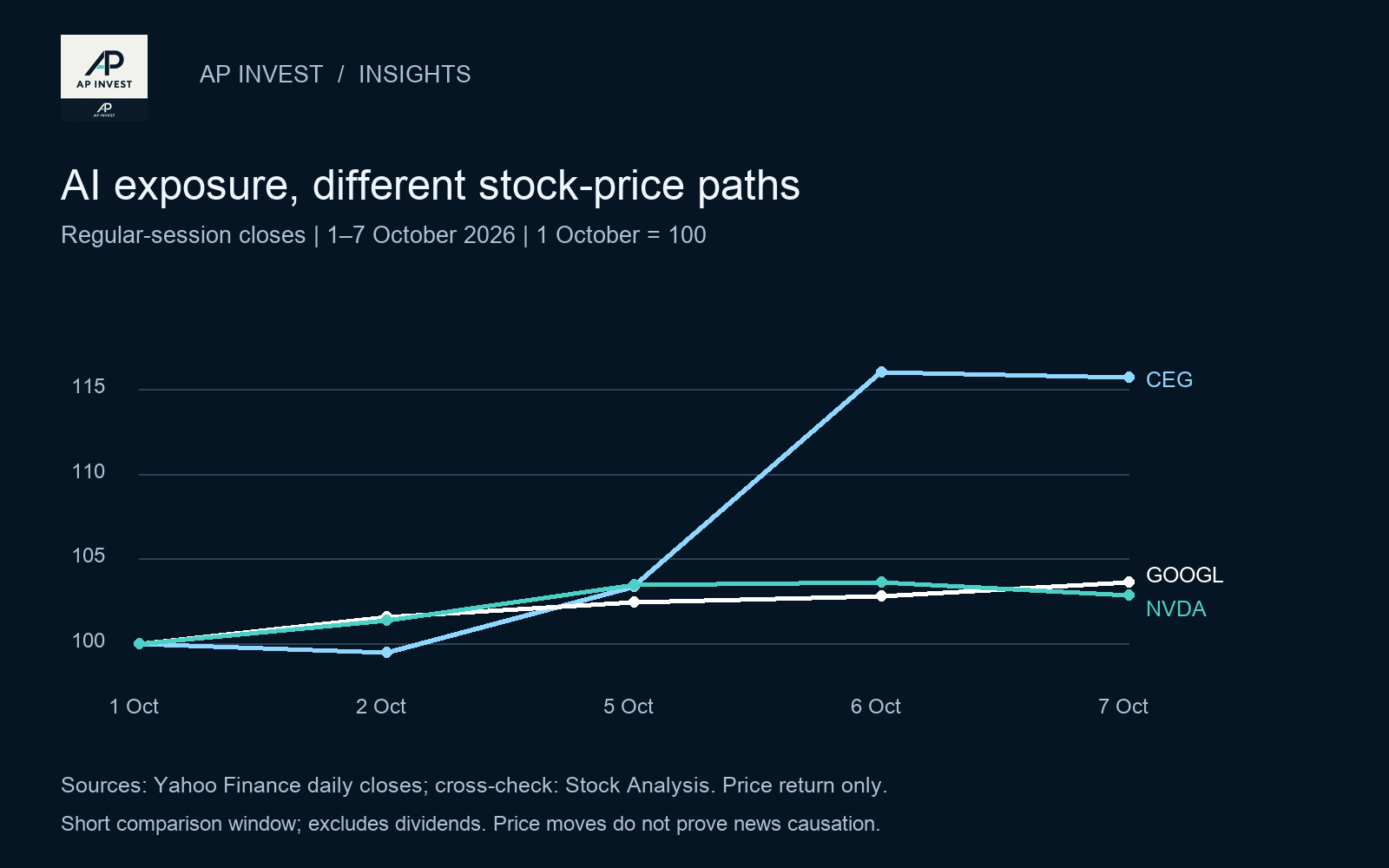
CEG rose 12.25% on 6 October and finished 7 October at $299.59, down 0.27% that day. That sharp move increases the importance of the entry valuation. It does not establish that the deal alone caused the rally, or that the investment will earn an adequate return from the new share-price starting point.
For CEG, focus on the return after project costs
A long contract can make demand more predictable. It does not automatically make a project highly profitable. Investors still need the achieved selling price, escalation provisions, fuel and operating costs, outage assumptions, construction spending and financing terms. A contract can reduce one risk while leaving others with shareholders.
Our framework is to follow incremental generation through operating profit, capital spending and financing to cash available per share. Watch whether the project budget changes as engineering advances, whether upgrades align with planned outages, and whether management discloses when earnings contributions begin. The announcement does not provide enough commercial detail here to calculate a defensible project return or stock-price target.
For Alphabet, power is an input to a larger business
Google says the collaboration is driven by data-centre growth and will combine physical upgrades with Google Cloud’s Gemini Enterprise. That gives Alphabet two relationships to examine: securing electricity for growth, and supplying technology to an energy operator. Neither relationship, by itself, proves an increase in group-wide margins.
Google: why it is backing existing nuclear plants ↗
The shareholder question is whether more dependable infrastructure supports profitable demand for cloud and AI services. Track utilisation, customer revenue and returns on the broader capital programme alongside energy commitments. A supply agreement can remove a constraint, but the buyer still needs customers willing to pay for the services built on that supply.
For chip exposure, ask a different set of questions
The chip-versus-power comparison is a comparison of business economics, not simply which industry has the strongest demand headline. For a semiconductor investment such as NVIDIA, examine product competitiveness, realised margins, customer spending durability and the pace of replacement cycles. For a generator, examine delivered output, contract margins and returns on physical assets. Both can benefit from the same spending cycle and still face very different risks.
Neither a lower share price nor a longer contract is a valuation shortcut. Compare sustainable earnings and cash flow with the price paid, and test less favourable assumptions. For CEG that could mean higher upgrade costs or a slower ramp; for Alphabet, weaker monetisation of new capacity; for a chip supplier, lower margins or more cautious customer spending. These are analytical scenarios, not forecasts.
AP INVEST’s takeaway
The agreement makes electricity supply a concrete part of the AI investment discussion. Our preference is to evaluate the specific cash-flow mechanism before choosing the theme: who spends first, who bears delivery risk, when cash arrives, and what the current valuation already assumes. CEG and Alphabet are direct participants; NVIDIA is a comparison, not a beneficiary established by this contract. The strongest investment case needs evidence beyond the largest megawatt headline.
Sources & scope
Prepared 8 October 2026. Company announcements are dated 6 October; stock data ends at the 7 October US close. Daily changes are calculated from consecutive rounded closing prices. The chart uses close ÷ 1 October close × 100, with equal spacing for trading sessions. Sources: the company releases and historical-price pages linked above, cross-checked with Yahoo Finance. No causal event study, project return estimate or buy/sell recommendation is presented.