
FAA disruption: what DAL, UAL and AAL investors should watch next
The ground stop ended. The investment question is how quickly airlines restore their networks—and whether the costs change their earnings outlook. Delta, United and American face the same event with different financial starting points.
What happened—and what remains uncertain
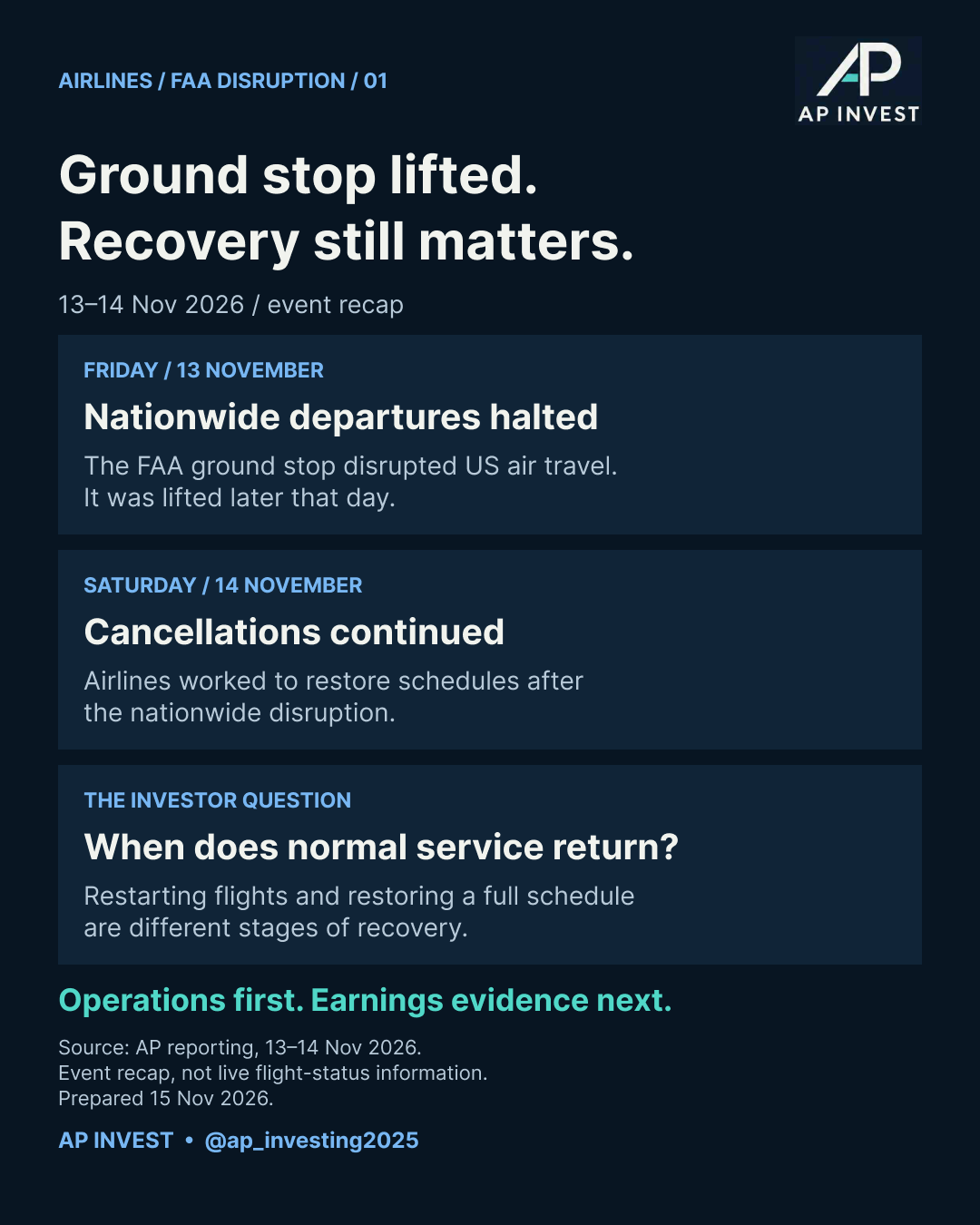
The FAA lifted Friday’s nationwide ground stop after communications problems interrupted US departures. AP reported continued cancellations on Saturday and an FAA expectation that schedules would recover by the end of Sunday. That was a forecast, not confirmation of a completed recovery. This article is a 15 November assessment, not a live flight-status service.
AP: ground stop lifted, 13 November ↗
AP: recovery outlook, 14 November ↗
The affected stocks: a consistent price cutoff
The table uses the 13 November 2026 regular-session close at 4 p.m. New York time (14 November, 5 a.m. Hong Kong). Prices are USD; daily changes are versus 12 November. These closes do not incorporate the subsequent weekend recovery news. A one-day price change also cannot isolate the financial effect of the disruption.
| Company / ticker | Close (USD) | Daily change |
|---|---|---|
| Delta Air Lines (DAL) | $86.25 | -0.30 (-0.35%) |
| United Airlines Holdings (UAL) | $109.31 | -1.94 (-1.74%) |
| American Airlines Group (AAL) | $13.17 | -0.14 (-1.05%) |
Price sources: DAL · UAL · AAL.
From canceled flights to cash flow
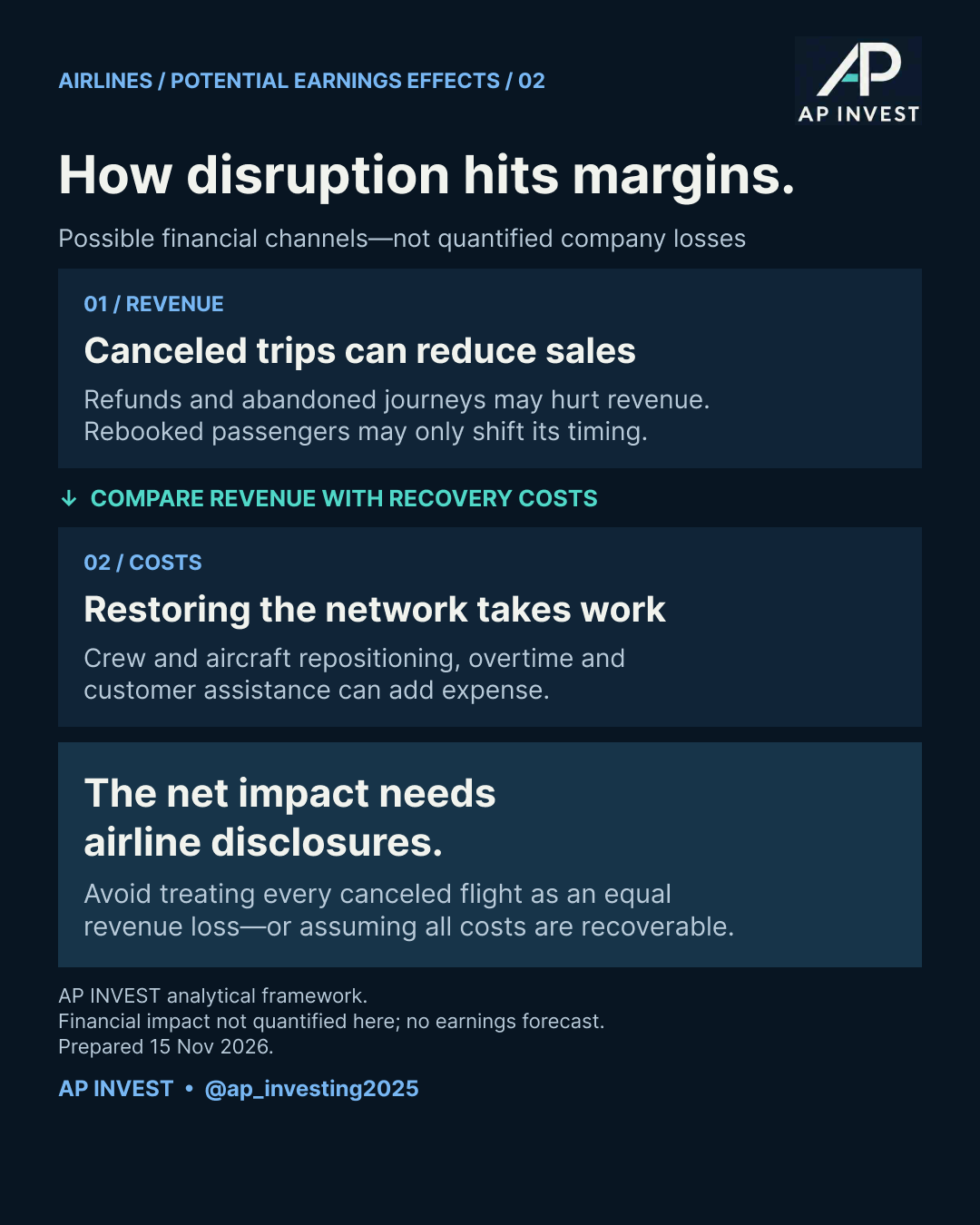
A canceled departure is not automatically a permanently lost ticket sale. Some passengers abandon the trip; others travel later. The investor’s task is to separate lost revenue from delayed revenue, then account for the expense of rebuilding the schedule. Aircraft and crews may need repositioning, while customer assistance and overtime can add costs. The extent depends on the airline’s actual recovery.
Avoid estimating losses by multiplying canceled flights by an average fare. That shortcut ignores passenger loads, connecting itineraries, rebookings and costs avoided when a flight does not operate. Nor should investors assume insurance or other recoveries will cover the bill without company evidence. The figures here illustrate possible channels; they are not estimates of company losses.
Delta: test the durability of premium demand
Delta’s September-quarter release reported 18% growth in premium revenue and a 9.4% adjusted operating margin, versus a 7.2% GAAP operating margin. Those results predate the disruption. They provide a baseline for assessing whether recovery costs are absorbed or pressure an already established earnings stream.
For DAL, watch operational reliability alongside premium bookings and the December-quarter outlook. A strong revenue mix is useful, but it does not make a network immune to disruption. A change in forward demand would matter more to a lasting valuation assessment than a temporary backlog alone.
Delta: September-quarter 2026 results ↗
United: follow network recovery and available liquidity
United reported third-quarter operating revenue of $17.9 billion and ending available liquidity of $17.7 billion. Its adjusted pre-tax margin was 6.2%, compared with 7.3% on a GAAP basis. Liquidity supports resilience, but the company’s defined available-liquidity measure should not be read as unrestricted cash alone.
For UAL, examine how quickly connecting itineraries and aircraft rotations return to plan, then look for disclosed recovery spending and changes in forward bookings. Do not compare United’s pre-tax margin directly with Delta’s operating margin: financing and other non-operating items sit between those measures.
United: third-quarter 2026 results ↗
American: the starting earnings cushion matters
American reported third-quarter revenue of $16.3 billion but a GAAP diluted loss of $0.41 per share; excluding net special items, the diluted loss was $0.28. Its presentation also reported a $1.9 billion year-over-year increase in fuel expense. These are pre-event results, not costs attributable to the FAA interruption.
For AAL, cash generation, liquidity and debt reduction deserve close attention alongside the recovery bill. An airline already reporting a quarterly loss has a different earnings starting point from a profitable peer. That does not establish which stock offers the best return: the price paid and the durability of future cash flow still determine the investment case.
American: third-quarter 2026 presentation ↗
What would change the investment case?
A short recovery with contained costs and unchanged demand would support treating the event as a temporary earnings interruption. Persistent cancellations, weakening bookings or reduced guidance would justify revisiting forecasts. Compare cancellation rates with each airline’s scheduled flights, not raw counts alone; larger networks naturally have more flights at risk.
Our conclusion is to monitor recovery first and revise earnings only when the evidence supports it. A lower share price is not a valuation argument by itself. Separate the temporary recovery bill from any lasting damage to demand or margins, then assess normalized earnings, capital spending and debt together. This article does not assign a buy/sell rating or a price target.
Sources & scope
Prepared 15 November 2026 from the linked AP reports, airline third-quarter releases and historical closing prices. Financial metrics retain their stated GAAP or adjusted definitions and are not a uniform ranking. No airline-specific loss from this event has been quantified here. Subsequent operational updates may change the assessment.