
Why a breakout is not automatically an entry
A breakout makes a stock a candidate, not automatically an entry. TWST’s 24 September 2026 breakout had strong volume but no later holding close; confirmation and a practical risk plan were still missing. Selection, confirmation and execution are separate decisions.
Why the stock reached the watchlist
The dated watchlist screened eligible US-listed stocks for liquidity and size, then examined price structure and relative performance within its theme framework. Its gates included at least $5 billion market capitalisation, a close of at least $10 and average daily close × volume of at least $50 million over the latest 50 completed sessions. This was a technical screen; earnings quality and valuation were not selection filters.
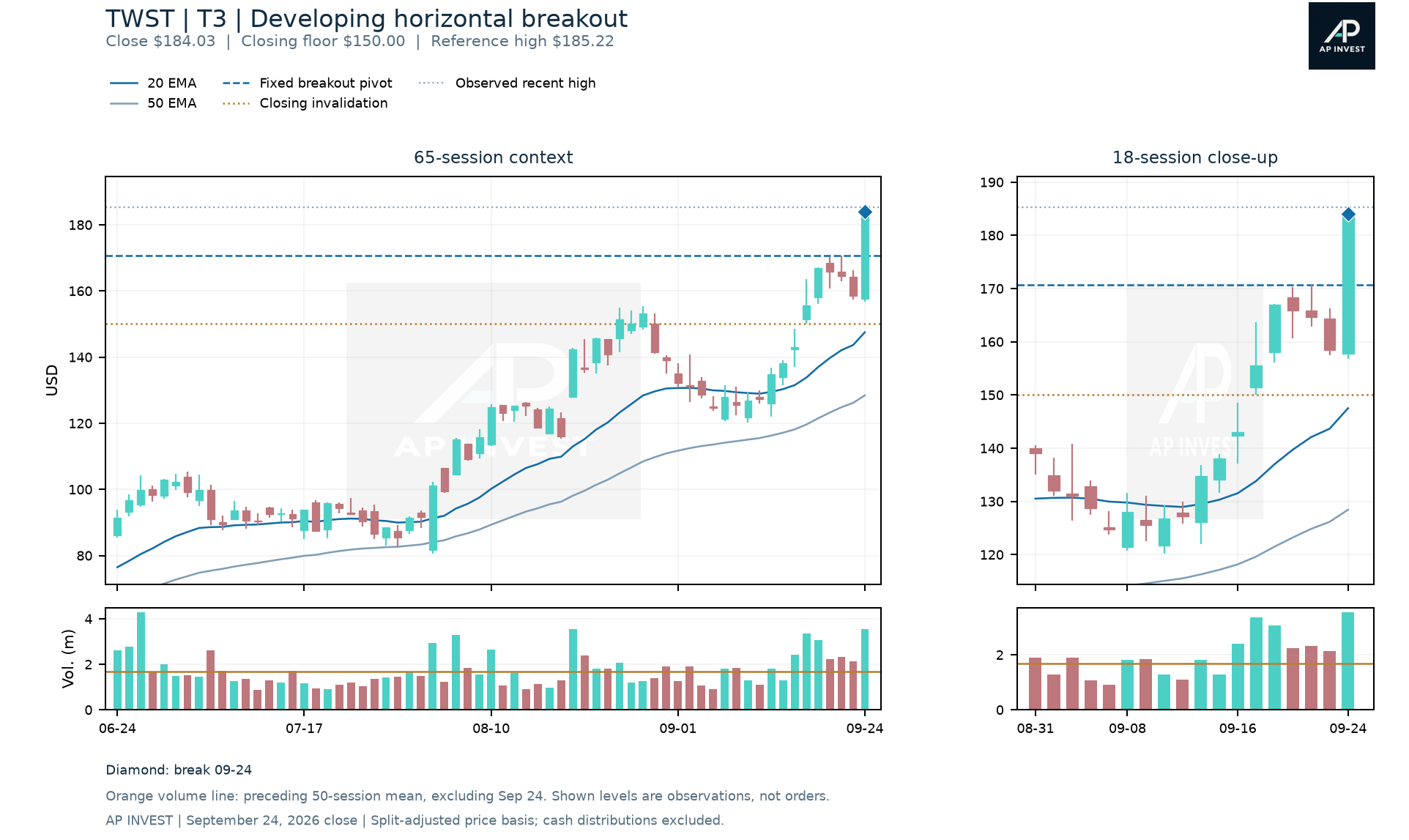
TWST appeared as a developing breakout. On 24 September, the report recorded a $184.03 close above a new $170.66 pivot, with breakout volume at 2.10 times the preceding 50-session average. The close was near the top of the session’s range. That evidence made it a monitoring candidate.
 STOCK WATCHLIST / TWST / 24 SEP 2026
What was still missing?
The breakout had happened that day. No subsequent completed session existed to show that the new pivot would hold. The report therefore kept TWST in Tier 3, its developing-setup category, instead of calling it a held breakout. High volume did not waive the later-hold requirement.
Candidate → confirmation → execution
- Observed
- A close above $170.66 on 2.10× the preceding 50-session average volume. This was a fresh breakout, not a quiet base.
- Interpretation
- Price and volume supported attention, but the breakout had not demonstrated persistence. Classification: developing setup, awaiting confirmation.
- Reassessment condition
- Require a later daily close above $170.66. A controlled retest holding the pivot could establish a new higher low; reassess the protective-stop reference only after that structure forms.
- Invalidation and missing evidence
- The source report’s structure was cancelled by a daily close below $150. That was a structural closing floor, not a final protective stop. Entry, practical stop, supported objective, event clearance and execution conditions still needed evaluation.
Why confirmation alone would not settle the entry
The report’s $185.22 upside reference was an observed 20-session high, not a target. It sat only $1.19 above the $184.03 close; the $150 structural floor was $34.03 below it. Those distances illustrate why using the floor as a stop and the high as a profit target would manufacture an entry plan the report did not support.
A later hold could improve the setup classification without making the entry attractive. A trader would still need a practical failure point, an independently supported objective and a check on current spreads and upcoming events. A stop order cannot guarantee its execution price through a gap.
The lesson to carry forward
Selection asks whether a stock deserves attention. Confirmation asks whether the expected price behaviour actually occurred. Execution asks whether the available entry and risk conditions fit the strategy. Passing the first test does not imply passing the next two.
This case preserves the information available at the original cutoff. It makes no claim that TWST later confirmed, failed or produced a particular return.
Sources & scope
AP INVEST Member Watchlist, 24 September 2026: page 11 for TWST, page 15 for eligibility and tier rules, page 18 for calculations and source notes. Completed Nasdaq daily history, cross-checked against Yahoo OHLC; split-adjusted prices exclude cash distributions. The volume baseline excludes the breakout session. Values are reproduced from that edition, not a fresh market-data calculation.
Technical-only historical example; final stop and reward-to-risk were not established. Reference levels are not current instructions. Order mechanics: SEC Investor.gov: Types of Orders. Source checked 2 October 2026.